
The crypto landscape is perpetually evolving, but the period between 2025 and 2026 is poised to witness a profound shift, moving past the speculative mania of previous cycles into an era of integrated utility and regulatory clarity. Following the Bitcoin halving and market consolidation, the next bull run will be defined by sectors that promise real-world functionality and cross-chain interoperability. While perennial trends like Bitcoin and Ethereum remain foundational, the true growth drivers will be Decentralized Finance (DeFi) and the integration of Artificial Intelligence (AI) within blockchain ecosystems
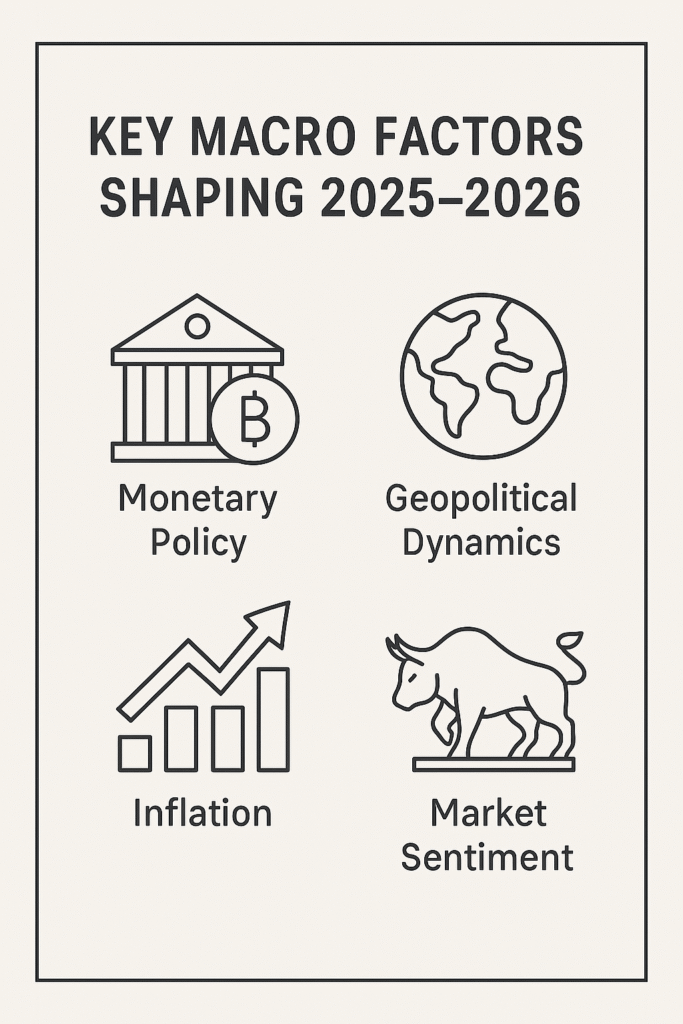
Key Macro Factors Shaping 2025-2026
The market trajectory is influenced by three major factors that will underpin all cryptocurrency trends 2025-2026:
Regulatory Maturation: The approval of spot Bitcoin and Ethereum ETFs in major jurisdictions (like the US) brings institutional capital and legitimacy. Clearer rules on stablecoins and digital assets will reduce regulatory uncertainty, paving the way for wider corporate adoption of blockchain technology.
Scalability Solutions: Ethereum’s move to Proof-of-Stake and the robust development of Layer 2 (L2) networks (Arbitrum, Optimism, Polygon) finally solve the long-standing problem of high fees and slow transaction speeds. This efficiency is critical for mass adoption of complex applications like DeFi and gaming.
Institutional Adoption: Banks, asset managers, and major corporations will accelerate their integration of decentralized technologies, not just as investment assets, but as infrastructure for tokenized real-world assets (RWAs) and cross-border payments.
Trend 1: The AI-Crypto Synergy and the Rise of AI Memecoins
The intersection of AI and blockchain is arguably the single most exciting development for cryptocurrency trends in the next cycle. This fusion is not limited to speculative tokens; it’s about creating decentralized, trustless, and more efficient AI services.
Decentralized AI Infrastructure
The core utility lies in decentralized AI computation and data marketplaces. Projects focused on this aim to break the monopoly of tech giants (Google, Amazon) by allowing individuals to rent out their computing power for AI model training or to monetize their unique datasets securely. This reduces censorship risk and lowers the barrier to entry for smaller AI developers.
The AI Memecoin Phenomenon
While utility tokens build the infrastructure, a surge in AI Memecoins is highly likely. These tokens capitalize on the massive hype surrounding AI, often featuring AI-themed branding or light AI-related utility (such as AI-powered trading bots or image generation).
Note: While some AI memecoins may offer substantial short-term gains due to viral hype and liquidity, investors must exercise caution. True long-term value will reside in protocols that solve concrete, verifiable problems in the AI supply chain.
For 2025-2026, look for the following sub-trends:
Decentralized Inference: Using blockchain to verify the output of AI models.
Data Provenance: Tracing the origin and ownership of data used to train AI models using NFTs or other tokens.
AI-Driven Trading: Integration of AI models directly into on-chain DeFi protocols for automated liquidity provision and risk management.
Trend 2: DeFi’s Second Wave – From Speculation to Institutional Utility
Decentralized Finance (DeFi) has evolved past its initial high-yield farming phase. The next evolution, often termed DeFi 2.0 or Institutional DeFi, will focus on stability, compliance, and linking traditional finance (TradFi) with on-chain protocols.
Real-World Assets (RWAs) Tokenization
The tokenization of Real-World Assets (RWAs)—such as real estate, corporate bonds, treasury bills, and commodities—is expected to be a multi-trillion-dollar industry by 2030. In the 2025-2026 cycle, RWAs will become the primary mechanism for institutional money to enter the DeFi space. Tokenized bonds offer clear, compliant yields, making them far more attractive to banks and asset managers than volatile crypto-native yields.
Impact: RWAs provide DeFi protocols with verifiable collateral and sustainable yield sources, increasing the overall stability and credibility of the decentralized financial system.
Institutional-Grade DeFi (Permissioned Pools)
To comply with global Anti-Money Laundering (AML) and Know Your Customer (KYC) regulations, dedicated, permissioned DeFi pools will gain traction. These pools require participants to be verified entities, effectively blending the security and transparency of blockchain with the compliance requirements of TradFi. This enables major financial players to utilize DeFi primitives (lending, borrowing, automated market-making) without violating regulatory mandates.
Trend 3: Interoperability and Modular Blockchains
The future is multi-chain, and the demand for seamless asset transfer and communication between blockchains is paramount. Interoperability solutions will move beyond simple cross-chain bridges to become foundational layers.
Modular Architecture: The shift towards modular blockchains (separating execution, consensus, data availability, and settlement layers) allows chains to scale more efficiently. Projects that provide Data Availability (DA) or efficient execution layers will be critical infrastructure plays.
Improved Bridges and Communication Protocols: New protocols will address the security vulnerabilities of older cross-chain bridges, facilitating secure communication between Ethereum, Solana, Cosmos, and other emerging Layer 1s and Layer 2s. This seamless flow of capital is vital for maximizing liquidity across the entire decentralized ecosystem.
Trend 4: Gaming and Consumer-Facing Adoption
While previous cycles saw speculative hype around Metaverse tokens, 2025-2026 will focus on actual in-game utility and ownership.
Web3 Gaming Evolution: Games will prioritize the “fun factor” over the “earn factor,” with blockchain technology serving as a subtle layer for asset ownership (NFTs) rather than a central economic mechanism. True ownership of in-game items, not speculative “play-to-earn” models, will drive adoption.
Consumer Apps and Wallets: Simpler, more intuitive wallets and applications will be necessary for onboarding the next billion users. Account Abstraction (AA) technology will make wallets function more like traditional apps, eliminating complex seed phrases and high gas fees.
Conclusion: Maturity and Utility Defining the Cycle
The Cryptocurrency Trends 2025-2026 point toward a mature market focused on real utility. The hype cycle will be dominated not just by the quick gains of AI Memecoins, but by the foundational utility of DeFi protocols integrating multi-trillion-dollar RWAs. Success will hinge on solutions that are scalable, compliant, and deeply integrated with both decentralized AI and traditional finance. Investors and builders must look past mere speculation to identify projects that are genuinely solving complex, high-value problems in the digital and physical worlds. The next bull market will reward utility over hype.
Mega Financial Forecast for 2026: Bitcoin, XRP, SSE, and Top Investment Picks
XRP in 2026: Regulatory Clarity and Global Adoption
Bitcoin 2026: The Calm Before the Next Bull Storm?
Binance Crypto Exchange: What Makes It the Leading Global Platform?


 Bitcoin
  Ethereum
  Tether
  XRP
XRP  BNB
BNB  USDC
USDC  Solana
  TRON
TRON  Dogecoin
  Bitcoin Cash
  USDS
USDS  Litecoin
  PayPal USD
  Sui
Sui  USDT0
USDT0  Ethereum Classic